November 6, 2006
Biodegradation systems for petroleum hydrocarbons
Abstract: Crude oil is processed into petroleum, plastics, and many other substances. Oil is composed of polycyclic aromatic hydrocarbons (PAH), which, because of their resistance to decomposition, are persistent, as well as toxic. Researchers are studying the capacity of white rot fungi, of co-evolved micro-organisms on natural oil seeps, and of bacteria to decompose hydrocarbons. Looking to scientific research for biophysical guidance, to the sustainability community for ecological models, and to the emerging wisdom of systems theory for design and process considerations, an integrated approach to waste management can be considered. Locally adapted ecosystems cultivated for PAH decomposition could turn a problem into a resource both biologically and socio-economically through job-creation.
Introduction
Modern life uses vast quantities of oil. It is transported, refined, and manufactured into a huge number of products, including plastics. Oil is composed of tightly bonded hydrocarbon chains. Total petroleum hydrocarbons (TPH) are a large family of chemicals derived from crude oil which enter the environment through soil or air, and cause nervous system, lung, kidney, and liver damage (ASTDR, 1999). From the incomplete burning of oil comes polycyclic aromatic hydrocarbons (PAH), which are suspected carcinogens, and are found in medicines, plastics, pesticides, and asphalt ( ATSDR 1995). PAH are persistent toxins that are mainly of anthropogenic origin, and are found to accumulate in areas of exposure (Trapido, 1998). Gaseous and condensed PAH can be carried long distances before being deposited (Wania & MacKay, 1996). Occasionally, crises occur where large quantities oil enter the ecosystem, such as oil spills, or storms, such as Hurricane Katrina. Both in manufacture and in disposal, more and more hydrocarbon compounds are being introduced into the environment.
Research regarding the biodegradation of hydrocarbons has mainly centered around the family of white rot fungi (WRF) because of their lignin-degrading capacity. Tests show greater decompositional efficiency by WRF in a water substrate and less efficiency in soil substrate (Boyle et al., 1998). Research testing a number of varieties of WRF for PAH removal from gas-manufacturing contaminated soil showed an overall average of 30% PAH decrease in the first month (Sasek et al., 2003; Rudd et al., 1996). Growth seems negatively affected by nitrogen additions, and additions of alfalfa or sawdust also impede remediation slightly (Boyle et al., 1998). Of note, WRF that had been previously exposed to PAH exhibited faster decomposition, inferring induciblity (Boyle et al., 1998).
Another area of research regarding hydrocarbon biodegradation is observing the co-evolved ecosystems of natural oil seeps. At an active natural oil seep along the Dorset Coast, UK, researchers analyzed acidophilic microbial communities, and recorded complete degradation of PAH as well as other compounds by both bacterial and fungi (Roling et al., 2005).
Operating in parallel to the academic community is what I will refer to as the sustainability community, by which I mean the movements and institutes of permaculture and sustainable design. Combining science, ancient wisdoms, traditional knowledge, ecology, and system theory, this community has created a large body of knowledge on low-technology, low-impact, ways of living in a relationship of mutual enhancement with the earth. The ability of fungi to bioremediate has been of much interest here for while, with Paul Stamets leading the research. Recently, Battelle, a global (Ohio-based) science and technology enterprise, performed tests involving a number of strategies to bioremediate crude-oil saturated soil: while the conventional chemical and bacterial attempts revealed little noticeable change four weeks after treatment, the area that was inoculated by Stamets with a diversity of fungi, including the common and delicious Oyster mushroom, showed not only rapid decomposition, but a much accelerated succession to a vegetated state (Stamets, 1999). Analyses showed PAH degradation to be 95%, and constituents reduced to non-toxic components; the mushrooms even tested free of toxins (Stamets, 1999).
Bridging the gap between these communities is systems theory. System theory/thinking/dynamics has given us whole new ways of looking at how everything works in relationship. From this exciting, emergent body of knowledge, we better understand how ecological systems and social processes function and evolve. This gives us tools for designing and altering physical systems, as well as tools for creating change in existing social systems. Through observant design that mimic natural systems, incorporating feedback and meta-feedback loops, we can support the forces and processes that help a system to run itself (Meadows, 2001). Biological systems are multi-functional, self-producing, self-cleaning, co-evolving processes, making them viable options if a strict definition of sustainable is adopted and aspired to (Capra, 1996).
A system is truly sustainable if it is: mutually enhancing to the human and non-human communities; provides habitat for biodiversity; is economically viable to create and maintain by both wealthy and poor communities; and is designed for flexibility in its long term functioning. Using this definition, this paper will examine what systems are creatable at a local level to deal with the plethora of hydrocarbons, and what some strategies to create change may be.
Methods
The main method used was research through both the academic and sustainability cannons, supported by observation of natural systems. This paper combines both scientific, peer-reviewed journal articles, and case studies performed by players in the sustainability arena. Three years of soil observations in a variety of ecosystems and while provides my framework for understanding.
I will focus mainly on the praxis of addressing the problem in the bulk of this paper, rather than the socio-political systems that function to create, propagate, and exacerbate the problem. My biases towards decentralization and a devotion to an environmental ethic are visible within my definition of sustainable.
Discussion
Analysis
Current oil production is around 83.3 million barrels a day (Worldwatch, 2006). Crude oil is a persistent toxin. It is made of a tightly-bonded structure of hydrocarbon chains, and comes mainly from anthropogenic sources; these hydrocarbons are resistant to decomposition. Polycyclic aromatic hydrocarbons (PAH) are of particular concern as they are potentially carcinogenic, according to the US EPA (ASTDR, 1995). PAH can be found in medicines, plastics, dyes, asphalt, oil, smoke, charcoal, and tar (ASTDR, 1995). They are beginning to be found globally in increasing amounts in the humus layers of soil (Roling et al., 2005).
In 2000, Ontario produced 67,916 tonnes of plastic garbage, 22, 040 tonnes of which were recovered (Envirosis, 2001). Current waste management involves the conventional practices of creating landfills, incineration, and recycling. These practices do not involve the direct and efficient decomposition of persistent toxins, but rather only function to contain or proliferate them. The production and externality costs of landfilling are high (Miranda and Hale, 2004), as landfills are filling up, and governments are facing an inability to site new waste disposal locations (Hostovsky, 2006). In exacerbation, the predicted energy crisis will negatively affect our current centralized waste management system. High production of TPH and PAH are coinciding with problematic waste management strategies. As well, crises such as spills and storms, can contribute to TPH and PAH to the environment in a disastrously abrupt way. New Orleans, after Hurricane Katrina, is an example of a post-crisis site with heavy terrestrial and aquatic contamination; clean-up efforts are still underway.
Conventional methods for treatment of TPH and PAH contaminated sites often involve a pump-and-treat strategy, involving excavation before treatment, but excavation demands a high cost in energy, footprint and finance, limiting the possibility of its application. Treatment can also occur in situ: these include incineration, containment, oxidation, and biological means. Incineration offers the potential to harvest energy through waste-to-energy (WTE) technologies, and could potentially be economically viable (Miranda and Hale, 2004), but it creates more PAH, making it a much less efficient option in the long term. Containment creates anaerobic environments, slowing decomposition; oxidation is used to accelerate decomposition. Oxidation and aeration can occur through physical or chemical processes; hydrogen peroxide and ozone oxides can be used; increased levels of oxygen work to increase microbial metabolism as well as accelerate chemical reactions (Wikipedia, 2006a).
Current biological methods involve the metabolism of microbial populations, including bacteria, fungi and enzymes, as well as the possible use of plants, to convert problematic hydrocarbons to bio-available components (Wikipedia, 2006a). Biostimulation, through enhancing conditions for native populations, and bioaugmentation, by the addition of suitable but non-native species, are used depending on the situational context. Biostimulation generally involves the addition of nutrients, such as potassium, nitrogen, calcium and molasses (Wikipedia, 2006b); the environmental affects of such inputs must be monitored for tertiary impact, as some research suggest that nitrogen inputs may actually act to reduce fungal activity (Boyle et al,1998).
Scientific study around the biological degradation of problematic hydrocarbons has primarily explored the capacity for white rot fungi (WRF) to decompose PAH. WRF are a large family with the unique capacity to biodegrade lignin completely down to carbon dioxide; lignin is a natural polymer of cell walls in trees which give strength and contains the cellulose molecule that WRF can use as an energy source (Aust & Bensen, 1993). The fungi uses an extra-cellular and non-specific system of chemical production to decompose the tight carbon bonds, which also explains their resistance to toxic or mutagenic chemicals (Aust & Bensen, 1993). Results reveal faster decomposition in water substrates, and slower decompositional processes in soil (Boyle et al.,1998). Research testing PAH removal from gas-manufacturing contaminated soil by WRF Irpex lacteus and Pleurotus ostreatus, with bacterium Psuedomonas putida, showed, though all to be capable at decomposition, I.lactues to be most efficient, alone or in co-culture with bacteria (Sasek et al., 2003). The fungi to be capable of decomposing PAH and TPH down to bioavailable carbon dioxide and water (Sasek et al., 2003). Decreases in mutagenicity of crude oil have also been observed by decomposition by Cunninghammella elegans and Penicillium zonatum (Rudd et al., 1996).The growth of WRF, in this case Trametes versicolor Pilat strain 52P, was negatively affected by nitrogen inputs (Boyle et al., 1998), an observation supported by the decrease in agricultural mycorrhizae with increase in soluble potassium fertilizers (Kramer & Morely, 1990). Of note, it has been observed that WRF previously exposed to PAH exhibited faster decomposition, inferring the capacity for fungi to be cultivated for greater efficiency (Boyle et al., 1998).
Another area of research regarding hydrocarbon biodegradation is observing the co-evolved ecosystems of natural oil seeps. At an active natural oil seep along the Dorset Coast, UK, researchers analyzed acidophilic microbial communities, and recorded complete degradation of PAH as well as other compounds by both bacterial and fungi (Roling et al., 2005). This knowledge can aid bioremediation design to create optimal conditions, and asses measurement parameters (Roling et al., 2005).
The sustainability community has been looking at biological methods of pollution clean-up for the past 30 years from more of a low-tech, low-cost perspective. Working between this group and the scientific community, Paul Stamets has helped fungi reveal its potential to render hydrocarbons bioavailable; the difference is that Stamets is not using only WRF, but a broad variety of fungal species, including the delicious edible ‘oyster’ mushroom. In 1999, Battelle, a science and technology enterprise based in Ohio, conducted an experiment; they invited leading groups with the leading bioremediation technologies together to conduct a simultaneous test on crude oil saturated soil: while chemical, and bacterial strategies showed little improvement, the fungi inoculated pile by Stamets not only showed PAH reduction of 95%, but the fungi acted as a keystone species in accelerating succession: by attracting insects, birds came, bringing seeds, an accelerated succession to vibrant vegetation occurred, without intervention (Stamets, 1999). The mushrooms were even tested free of toxicity (Stamets, 1999). Battelle concluded that mycoremediation is safe, economical, fast, does not generate any toxic side-effects, and in fact, produces a useful end-product, turning a liability into an opportunity (Thomas, 2000).
Assessment
It is known that PAH and TPH are persistent toxins increasing in our environment from primarily anthropogenic sources, and that conventional methods do not sufficiently remediate these compounds. High technology solutions requiring high energy inputs are not available in many situations for economic reasons, nor are they sustainable. Definitions of ‘sustainable’ are subjective, resulting in a high variability of ‘sustainable’ practices. To be clear, a system is only truly sustainable if it is: mutually enhancing to the human and non-human communities; provides habitat for biodiversity; is economically viable to create and maintain by both wealthy and poor communities; and is designed for flexibility in its long term functioning. Using this definition, this paper will examine what systems are creatable at a local level to deal with the plethora of hydrocarbons, and what some implications of such a system may be.
Scientific research enhances our understanding of specific, detailed processes, such as rates of decomposition by various species of fungi, as well as helps us understand the environment as a co-evolving ecosystem. The sustainability community has been working to integrate science and ancient wisdoms to design ways of living with low impact on the planet. While these movements are parallel, they also often diverge. Systems dynamics is scientific theory that can ecosystems in a holistic way shared by the sustainability community. It gives us scientific language and theory through which to frame our strategies.
System thinking is an emergent body of knowledge about living, moving, dynamic processes and patterns. Life is change and movement; everything is interdependent; the ancients knew this; systems dynamics give us scientific language to speak of these complexities. Systems thinking is, in a way, a whole new ontological Story that can completely shift one’s view on life, from seeing a collection of atoms and chemical processes, to seeing the planet as an organism, including everything upon and within the planet. This ontological shift is necessary in reducing the toxicity of the environment, and in shifting the strategy we use to address existing toxins (Berry, 1999). Systems theory is language we can use to bridge the connections between science, spirituality, ecology, and society, as it is the language of connection. Some specific tools from systems dynamics include Donella Meadows’ “Leverage Points; places to intervene a system” (1999). Here she lists twelve such ‘locations’ in order of increasing effectiveness; within stocks and flows ratios, delay to change ratios, in feedback mechanisms, in information flows, rules, and goals of the system, are leverage points (Meadows, 1999). Another tool from the systems thinkers comes in the form of “Action to Outcome Mapping” (Jones & Seville, 2003). This is a strategy-testing tool for groups trying to achieve a broad, long-term outcome. By mapping out 1) existing causal theories, 2) adding feedback, 3) mapping critical mindsets, 4) accounting for external forces, and 5) identifying opportunities for learning, a strategy can be designed to be flexible, sustainable, and successful (Jones & Seville, 2003).
This gives us tools for designing and altering physical systems, as well as tools for creating change in existing social systems. Through observant design, feedback and meta-feedback loops, we can support the forces and processes that help a system to run itself (Meadows, 2001). Biological systems are multi-functional, self-producing, self-cleaning, co-evolving processes, making them viable options for the definition of sustainable aspired to.
Action
Goal
Sustainable waste management for TPH and PAH can occur through cultivating biological processes. Bioregionally adapted microbial species, both fungal and bacterial, capable of metabolizing hydrocarbons completely, should be cultivated at every waste management site. Through local development and sharing, microbial populations that are increasingly effective at metabolizing hydrocarbons can be cultivated with the wisdom of what functions efficiently at the local level. These sites can serve as nurseries for innoculant distribution, with the goal of increasing small systems that responsibly deal with waste. A network of systems within systems, integrating waste decomposition, resource creation, food production, and human habitation, can be created by the community, for the community, consciously using the wisdom of science, ancient knowing, and systems theory.
Tactics
The deeper goal of systemic change must accompany the discussion of waste management strategies. I stress the word discussion as it will also take much community dialogue, education, and planning to create the taking and sharing of responsibility that this
vision entails. Community design charrettes, designed and subsidized by CMHC, are a valuable method of bringing together the scientific community, the sustainability communities, planners, builders, specialists, government officials, and citizens. A community design charrette gives a format for a meaningful and constructive discussion to occur which produces a workable body of knowledge.
Preceding and concurrent to the community design charrette, effort would be necessary to educate the public, lobby government and industry, and create community support for a shift to biological methods of waste management. Media plays a key role in public awareness and opinion, and should be innovatively used. Ultimately, a closer intimacy with natural systems must be fostered so that people can better understand the planet as an organism, made of interdependent systems within complex system, with every action having affect. Becoming intimate with natural systems will help us integrate the many available knowledge sets into a well-designed strategy for sustainable waste management.
Conclusions
It is known that PAH and TPH are persistent toxins increasing in our environment from primarily anthropogenic sources, and that conventional methods are not able to completely remediate these compounds. Sufficient research exists in the scientific community, as well as in the sustainability community, to deem biological remediation safe, effective, and affordable. Certainly, case studies show that bioremediation using a diverse range of fungi species can biodegrade PAH to benign bio-available substances, and accelerates succession; in a mutually beneficial way they can turn a liability into a resource. Biological methods of waste management should be incorporated into every municipal waste management site. These sites can function as research stations and nurseries to support a multiplicity of responsible small systems. Decentralization of the system will reduce transportation and energy expenditures, and will distribute resources more widely. Using community design charrettes and action-to-outcome mapping, a locally viable system of multiple systems that work in a mutually enhancing way can be designed.
Literature Cited
ATSDR: Agency for Toxic Substances and Disease Registry. U.S. Department of Health and
Human Services. 1999. ToxFAQs for Total Petroleum Hydrocarbons. http://www.atsdr.cdc.gov/tfacts123.html
ATSDR: Agency for Toxic Substances and Disease Registry. U.S. Department of Health and
Human Services. 1995. ToxFAQs for Polycyclic Aromatic Hydrocarbons.
http://www.atsdr.cdc.gov/toxprofiles/phs69.html
Aust, S; Benson, J. 1993. The fungus among us: the use of white rot fungus to
biodegrade environmental pollutants. Environmental Health Perspectives, Vol
101(3): 232-233.
Berry, T. 1999 The Great Work: Our way into the future. Bell Tower, New York.
Boyle, D; Wiesner, C; Richardson, A. 1998. Factors Affecting the Degradation of
Polyaromatic Hydrocarbons in Soil by White Rot Fungi. Soil Biol. Biochem. Vol 30, No 7: 873-882.
Capra, F. 1996. The Web Of Life: A New Scientific Understanding of Living Systems. Anchor
Books, New York.
Envirosris. Plastic Waste Management Strategy for Ontario. 2001.
Hostovsky, C.2006. The paradox of ration comprehensive model of planning: tales
from waste management planning in Ontario, Canada. Journal of Planning,
Education and Research 25: 382-395.
Jones, A; Seville, D. 2003. Action to Outcome Mapping: testing strategy with systems thinking.
Systems Thinker Vol. 14 (2): 9-11.
Kramer, D; Morely, P. 1990. “The Hidden World of Mycorrhizae”. Gleanings from
Canadian Organic Growers. Canadian Organic Growers, Ottawa, Ontario; 59-61.
Meadows, D. 1999. Leverage Points: places to intervene in a system. Sustainability Institute.
http://www.sustainer.org/tools_resources/papers.html
Meadows, D, 2001. Dancing with Systems. Whole Earth, Winter: 27 –234.
Miranda, M; Hale, B. 2004. Paradise recovered: energy production and waste
management in island environments. Energy Policy 33: 1691-1702.
Roling, W; Ortega-Lucach, S; Larter, S; Head, I. 2006. Acidophilic microbial
communities associated with a natural, biodegraded hydrocarbon seepage.
Journal of Applied Microbiology 101:290 - 299.
Rudd, L; Perry, J; Houk, V; Williams, R; Claxton, L. 1996. Changes in mutagenicity
during crude oil degradation by fungi. Biodegradation 7: 335 – 343.
Sasek, V; Cajthaml, T; Bhatt, M. 2003. Use of Fungal Technology in Soil Remediation:
A Case Study. Water, Air and Soil Pollution; Focus 3: 5-14.
Stamets, P. 1999. Helping the ecosystem through mushroom cultivation. Whole Earth,
Fall. http://www.fungi.com/mycotech/mycova.html.
Thomas, S. 2000. Mushrooms: higher macrofungi to clean up the environment. Battelle
Environmental Updates, Fall. http://www.battelle.org/Environment/
publications/EnvUpdates/Fall00/article4.html
Trapido, M. 1998. Polycyclic aromatic hydrocarbons in Estonian Soil: contaminations
and profiles. Environmental Pollution 105: 67 –74.
Wania, F., MacKay, D. 1996. Tracking the distribution of persistent organic pollutants.
Environmental Science and Technology 30: 390A-396A.
Wikipedia, 2006a. Bioremediation. http://en.wikipedia.org/wiki/Bioremediation
Wikipedia, 2006b. Biostimulation. http://en.wikipedia.org/wiki/Biostimulation
Worldwatch Institute, 2006. Fossil Fuel Use Continues to Rise.
http://www.worldwatch.org/node/4243.
1.05.2007

States of Grace: book review
october 3, 2006
~book review~
Charlene Spretnak: States of Grace:
The Recovery of Meaning in the Postmodern Age
Using a multi-disciplinary and multi-leveled approach, Charelene Spretnak has written a book that is both a passionate call to reconnection and a guide on how to do so. States of Grace weaves together four of the great wisdom traditions and deconstructive postmodernism into a gestalt worldview she calls “ecological postmodernism”(230). Considering our current planetary situation, States of Grace is a concise illumination of worldviews that practice sane and sustainable ways of living. While the real key is personal experience, practice, process itself, Charlene Spretnak engages eloquently in ontological discourse, blending ancient with post-modern for a perspective broad and deep. Her hope is to give each reader some of the ancient spiritual keys in hopes that we can collectively shift away from hyper-exploiting our surroundings, and enjoy living, once again, in grace.
Charlene Spretnak has subtitled the book Recovery of Meaning in the Postmodern Age, referring to our current age as ‘postmodern’ in both to the philosophical movement characterized by Foucault and deconstructionism, and to the failure of modernity to deliver the great freedom it promised. Modernity chopped the world into little pieces, dividing and dissecting it into tidy, individually known bits of substance. Science became the worldview. In this century much soul and culture searching has been done in an attempt to understand humanity and whether/how we have wrought so much havoc. Postmodernism looks hard into culture creation through a process of deconstruction to see how culture is a self-organizing system: while the culture is a reflection of its citizens, it creates its citizens; while language is used as a symbolic order, it also works to create meaning, and further, these meanings then create reality. While postmodernism has been very useful in untangling how ideology is naturalized, normalized, and self-policed, Spretnak argues vehemently against the final discursive step of ‘Deconstuctionist Postmodern’ that is anti-essentialist, declaring there is no essential meaning in anything aside from social construction. Spretnak argues that this worldview is a continuation of the destructive disconnection of science and patriarchy, which has facilitated the hyper-exploitation of our habitat. Modernity devalued relationships and reformed life into mechanical metaphors; postmodernity gave us some powerful ontological tools, but also emptied everything of any essential meaning. The recovery of meaning is then by necessity a reconstructive journey, and the state of our habitat begs for immediacy. Where better for us to look than the spiritual traditions that have been around for hundreds upon hundreds of years.
The four wisdom traditions the book engages are Buddism, Native American Spirituality, Goddess-worship, and the Abrahamic religions. Though she focuses an aspect of each worldview, she cautions against taking only a piece and leaving the rest: it is better for one to hold the philosophy with integrity and engage the wisdom within its context. Buddism has focused intensely on the mind and has much to teach about observing patterns, meditation, gaining perspective, re-patterning ourselves, and engaging in the participatory universe. Native American spirituality has much to teach about living with this land, about living in prayer and gratitude for the generosity of life and land. The traditions of the great Goddess give deep and beautiful attention to the body, the senses, the erotic, the awesome wonder of fertility, and the power of ritual. The Abrahamic traditions offer guidance regarding our sense of social justice, describing how looking after others is part of the path to spiritual fulfillment.
Spretnak’s core intention is to move people beyond theory, apathy and meaninglessness into actively living in a passionate, conscious, and harmonious way. The key to creating these deep changes is in practice/ process/ experience/ ritual; the truth of our lives exists in our repeated daily actions. The four wisdom traditions herein all emphasize honoring the process, using ritual, and daily life as spiritual practice. She integrates postmodern science to support how we continually create ourselves through our experiences. Systems theory is post-mechanistic science that begins to understand relationship and process as equally important to substance. We and everything else exist in a continual state of relationship and flux, in which we affect everything and are affected by everything; in the language of Permaculture, everything gardens. We are interconnected in a continuous dance of interbeing, to use a term coined by Vietnamese monk Thich Nhat Hanh. This knowledge, though perhaps more poetic than scientific, lay at the core of most ancient worldviews. Disconnected mind and disconnected theory will not bring us into the deep understanding we need to live harmonious. We need to move back into relation, back into the continual process of our bodies, our environment, and our infinite interconnectedness.
As science now knows the Buddists knew long ago through their practice of observing the mind and nature: all is transitory and we are but vibration and oscillation. We are solid but in a continual state of flux; we are substance made of wave. There is paradox at core of life, referred to by Buddism in the Everything and the Nothing. I have taken to calling this the Great Paradox, and vision it as a yin-yang of two forces, each with a bit of the other, continually flowing, concurrently, creating possibility like a kaliedescope creates pattern. Western thought tends to see two forces as contradictory and tries to simplify them, but much is lost in the process. The ancient traditions honored the paradox, understanding that this flow is the creative matrix. I have encountered this idea in so many Indigenous paradigms that I have come to believe that the acceptance of this apparent paradox as non-problematic at the core of all things is essential to our paradigm shift. Spretnak has helped me to articulate myself regarding my position. She makes visceral an essentialist argument that at the core there is interconnection, continual flux and paradox: regardless of our social constructions there is something essential and with meaning. She uses a Christian term for this experience of this deep state: grace.
To be critical, there is a section in which I find her language a bit problematic. Her chapter on the Goddess tradition begins with pegging biological evolution as rooted in the male-female split, making it a duality is at our very core. The way she uses language in his chapter supports the idea that we are trapped in this binary. Spretnak goes on to compare patriarchal societies with gynocentric communities in a very bad-good sort of way. The stark contrast of these comparisons does not sit well with me. To me, they reinforce the concept of the binary, which I see as a false construction. I do not see things as a duality, or even a continuum, as both concepts imply a two-dimensional linearity; I see reality as more web-like, better visualized as a sphere. Beyond these two examples she does speak from a place of honoring the paradox, acceptance of the multivalent complexities, indeed, of grace.
In conclusion, I felt the book to be wonderful. It is academic, indexed, and well cited, while also being passionate and useful. This one book has helped my articulate my discomfort with Postmodernism, and realize that I do hold an essentialist viewpoint. Most importantly, the book has encouraged my resolve to commit to practicing Vipassanna meditation and ritual. I am deeply grateful for the read, for the academic dialogue through personal spirituality, combining discourse with physical practice. It is an eloquent map in ways to shift ideologies and ontologies, which is what our planet urgently needs.
~Works Cited~
Spretnak, Charlene. States of Grace: The Recovery of Meaning in the Postmodern Era. San
Francisco: Harper Collins, 1991.
~book review~
Charlene Spretnak: States of Grace:
The Recovery of Meaning in the Postmodern Age
Using a multi-disciplinary and multi-leveled approach, Charelene Spretnak has written a book that is both a passionate call to reconnection and a guide on how to do so. States of Grace weaves together four of the great wisdom traditions and deconstructive postmodernism into a gestalt worldview she calls “ecological postmodernism”(230). Considering our current planetary situation, States of Grace is a concise illumination of worldviews that practice sane and sustainable ways of living. While the real key is personal experience, practice, process itself, Charlene Spretnak engages eloquently in ontological discourse, blending ancient with post-modern for a perspective broad and deep. Her hope is to give each reader some of the ancient spiritual keys in hopes that we can collectively shift away from hyper-exploiting our surroundings, and enjoy living, once again, in grace.
Charlene Spretnak has subtitled the book Recovery of Meaning in the Postmodern Age, referring to our current age as ‘postmodern’ in both to the philosophical movement characterized by Foucault and deconstructionism, and to the failure of modernity to deliver the great freedom it promised. Modernity chopped the world into little pieces, dividing and dissecting it into tidy, individually known bits of substance. Science became the worldview. In this century much soul and culture searching has been done in an attempt to understand humanity and whether/how we have wrought so much havoc. Postmodernism looks hard into culture creation through a process of deconstruction to see how culture is a self-organizing system: while the culture is a reflection of its citizens, it creates its citizens; while language is used as a symbolic order, it also works to create meaning, and further, these meanings then create reality. While postmodernism has been very useful in untangling how ideology is naturalized, normalized, and self-policed, Spretnak argues vehemently against the final discursive step of ‘Deconstuctionist Postmodern’ that is anti-essentialist, declaring there is no essential meaning in anything aside from social construction. Spretnak argues that this worldview is a continuation of the destructive disconnection of science and patriarchy, which has facilitated the hyper-exploitation of our habitat. Modernity devalued relationships and reformed life into mechanical metaphors; postmodernity gave us some powerful ontological tools, but also emptied everything of any essential meaning. The recovery of meaning is then by necessity a reconstructive journey, and the state of our habitat begs for immediacy. Where better for us to look than the spiritual traditions that have been around for hundreds upon hundreds of years.
The four wisdom traditions the book engages are Buddism, Native American Spirituality, Goddess-worship, and the Abrahamic religions. Though she focuses an aspect of each worldview, she cautions against taking only a piece and leaving the rest: it is better for one to hold the philosophy with integrity and engage the wisdom within its context. Buddism has focused intensely on the mind and has much to teach about observing patterns, meditation, gaining perspective, re-patterning ourselves, and engaging in the participatory universe. Native American spirituality has much to teach about living with this land, about living in prayer and gratitude for the generosity of life and land. The traditions of the great Goddess give deep and beautiful attention to the body, the senses, the erotic, the awesome wonder of fertility, and the power of ritual. The Abrahamic traditions offer guidance regarding our sense of social justice, describing how looking after others is part of the path to spiritual fulfillment.
Spretnak’s core intention is to move people beyond theory, apathy and meaninglessness into actively living in a passionate, conscious, and harmonious way. The key to creating these deep changes is in practice/ process/ experience/ ritual; the truth of our lives exists in our repeated daily actions. The four wisdom traditions herein all emphasize honoring the process, using ritual, and daily life as spiritual practice. She integrates postmodern science to support how we continually create ourselves through our experiences. Systems theory is post-mechanistic science that begins to understand relationship and process as equally important to substance. We and everything else exist in a continual state of relationship and flux, in which we affect everything and are affected by everything; in the language of Permaculture, everything gardens. We are interconnected in a continuous dance of interbeing, to use a term coined by Vietnamese monk Thich Nhat Hanh. This knowledge, though perhaps more poetic than scientific, lay at the core of most ancient worldviews. Disconnected mind and disconnected theory will not bring us into the deep understanding we need to live harmonious. We need to move back into relation, back into the continual process of our bodies, our environment, and our infinite interconnectedness.
As science now knows the Buddists knew long ago through their practice of observing the mind and nature: all is transitory and we are but vibration and oscillation. We are solid but in a continual state of flux; we are substance made of wave. There is paradox at core of life, referred to by Buddism in the Everything and the Nothing. I have taken to calling this the Great Paradox, and vision it as a yin-yang of two forces, each with a bit of the other, continually flowing, concurrently, creating possibility like a kaliedescope creates pattern. Western thought tends to see two forces as contradictory and tries to simplify them, but much is lost in the process. The ancient traditions honored the paradox, understanding that this flow is the creative matrix. I have encountered this idea in so many Indigenous paradigms that I have come to believe that the acceptance of this apparent paradox as non-problematic at the core of all things is essential to our paradigm shift. Spretnak has helped me to articulate myself regarding my position. She makes visceral an essentialist argument that at the core there is interconnection, continual flux and paradox: regardless of our social constructions there is something essential and with meaning. She uses a Christian term for this experience of this deep state: grace.
To be critical, there is a section in which I find her language a bit problematic. Her chapter on the Goddess tradition begins with pegging biological evolution as rooted in the male-female split, making it a duality is at our very core. The way she uses language in his chapter supports the idea that we are trapped in this binary. Spretnak goes on to compare patriarchal societies with gynocentric communities in a very bad-good sort of way. The stark contrast of these comparisons does not sit well with me. To me, they reinforce the concept of the binary, which I see as a false construction. I do not see things as a duality, or even a continuum, as both concepts imply a two-dimensional linearity; I see reality as more web-like, better visualized as a sphere. Beyond these two examples she does speak from a place of honoring the paradox, acceptance of the multivalent complexities, indeed, of grace.
In conclusion, I felt the book to be wonderful. It is academic, indexed, and well cited, while also being passionate and useful. This one book has helped my articulate my discomfort with Postmodernism, and realize that I do hold an essentialist viewpoint. Most importantly, the book has encouraged my resolve to commit to practicing Vipassanna meditation and ritual. I am deeply grateful for the read, for the academic dialogue through personal spirituality, combining discourse with physical practice. It is an eloquent map in ways to shift ideologies and ontologies, which is what our planet urgently needs.
~Works Cited~
Spretnak, Charlene. States of Grace: The Recovery of Meaning in the Postmodern Era. San
Francisco: Harper Collins, 1991.
The Cosmos In Lady Manzanita: process and the Great Paradox
On the land between two lakes, just south of the centre of Cortes Island there is a park called Kw’as. The road wraps around the northwest side and takes not long to pass by. There is a small parking lot with a great big signs, a map, and a bucket of handmade walking sticks.
The trees are big, and occasionally cars rest in the parking lot; otherwise the park is somewhat nondescript from the roadside. As the road wraps around, the land comes to rest at the edge of little Gunflint Lake, opal in shape and energy. For a couple of hundred meters the road runs right along the lake, affording beautiful views of moon reflections, simple shorelines, and the thriving forests of Kw’as.
I lived on the other side of this lake on a 300 acre land trust home to the Linnaea Garden program. From the Linnaea farmhouse there was a trail that headed down through the orchard, and up the hill towards Cortes Bay. At the crest of the hill, a much smaller path crossed. Going left, the trail climbs up to the dome of views known as Easter Bluff; by banking right, the trail skitters along a steep side, ducking down through a huge stand of second growth, and then either cross into Kw’as or up into town. (What wondrous land that one can still walk distances through forests!).
The ridge is finger of granite, carved by the paths of the ice flows long ago. It is fairly high, harboring huge trees and an incredible diversity of fungi that only makes itself visible only occasionally in a perfect autumn. From the heights, the lake glimmers in sky whites, clear blues, and forest greens.
The spine submerges its nose to allow the water a passage. A handmade bridge of a simple curve spans the pass. The water is a blue necklace, framed in veils of Sweet Gail, detailed with yellow water lilies.
You are standing on a bridge between the two lakes, on an island the ocean, cozy in the Strait of Georgia.
With forests in two directions and lakes front and back there is reflection, repetitions and differences; oftentimes I got the sense of dizziness, of being at the centre of a spiral or of a kaliedescope.
Years ago I sought the word for this sensation, asking what the word was for the sense of vertigo one gets from looking up, but no one could tell me of a single word. Now I know it is a part of axis mundi.
An axis mundi is, as it sounds, an axis of the world. In his 1957 book, The Sacred and the Profane, Mircea Eliade described Systems of the World his sense of order of the known world, in four parts. First there is a break in the homogeneity; the sacred becomes visible; there is communication with the cosmos and this forms an axis mundi; surrounding this axis is the known world.
I am not so magnificent in my metaphors as Eliade yet. I see the experience of spirit manifest is a mind-frame, a framework even. It is a choice. ( There are different social locations with different levels of privilege, imbricated in the physical world, limiting choices, and for some survival is priority). The sacred is everywhere, not only in the heavens, it is in every form and pattern. I must agree though that this acknowledgement does so often leads one’s attention up and open to the cosmos in gratious ( is there a connection between grace and gratitide: gracious and gratious?)
I am a child of quantum theory and celebrated that if science measured the wave, they could not measure the particle, and if they measured the particle, they could not measure the wave. I knew that there was more than one way; I know that reality occurred on a number of levels, as I can now see in post-structural theory that articulates how the axis of inquiry affects what and how we see.
After taking my time speak to each of the directions, to ask for help, give gratitude and let go, I would dive into the grand old growth of Kw’as.
Her trees are huge. Western Red Cedar and Douglas Fir grow in a thick duff floor. The trails branch: to the right many trails wind through the gentle lowlands that border Gunflint Lake, sweet and soft in their protection. To the left, the land borders Haigh Lake, an area with more of a tough-love energy, a bit like a bigger sibling.
It is closer to the ocean on the western side: the winds gather strength as they travel up the channel from the southwest, coming over the land, and dancing down into the lake’s open expanse. The feeling is more open and transparent, though almost demanding in that clarity. The forest all along the lake’s edge is laced with the tall silver watchtowers of standing -dead trees, often holding one, or a number of, big bald eagles.
I would head left, using the rope ladder to aid my way up the granite blocks sporting their graffiti of lichen. A thick cloak of moss held in the graceful forms of Arbutus trees, stretching their strength from cracks in the stone to a puff of leaves in the sky. Pine and huckleberry grew here and there on the high and dry; choruses of fir and hemlock grew thick and regal where the water was. The trail ran along the edge of land, say 50m above the lake, affording views of the lakes edge most of the way around: the world is a goddess wearing jewels of sky and full skirts of forest: patterns of stunning beauty.
I arrived on Cortes with all my arrogance and ache. It took a few months before the health of those near exposed me to my own set of defenses, how those defenses affected my relationships, how the quality of individual relationships form a community, and how a healthy community is in relationship with the land.
I was forced to accept that I was not all I made myself out to be; I could no longer ignore the things I pretended were not hurting me. In the colloquial, my issues were coming up and I starting working on my sh*t. As I did when I was a child, I went to the forest to shed my tears and work myself out. While the community reflected my health back to me, the forest was free of judgment and expectation.
In all of the healing arts that I have engaged in since, -Process painting, Heller work, 5 Rhythms Dance, Ecstatic Dance, yoga,- as with emergency response, the first step is to find or create a safe place. A place free of danger, expectation and judgment is necessary for a person to begin healing, trusting, and engaging in personal work. (Although recently I heard someone begin with, "I do not believe in safety." And now, to me, that ressonates).
I went to the forest with my shame and my courage to lay myself bare. It judges not, nor rushes me, but patiently and supportively listens. It does not take it on, take it personally, or hold it against me. I offered up my pain to get composted back in the food chain, letting Earth have all that energy back, trusting that I will receive everything I need. At times I felt the forest loud and jubilant in its support of me, singing as a gospel chorus in a southern church rejoicing a miracle, and bursting forth in praise of creation.
I began to shed my illusion.
I began to open myself up to darkness as a teacher, to my imperfections becoming my strengths. I worked to reroute thought patterns, and untangle my skeleton back to litheness. In my steps, in my breaths, in my cells, I began to accept and cleanse each fiber of me, and began to rebuild my relationships. I worked to get back into my body, and into the present. More of the forest and less of me, I breathed the forest in and everything I did not need out. I remembered that the forest needs my healthiness too. I tried to be aware of all the levels of life occurring concurrently, and to be a healthy vortex of energy moving through it.
The process of healing and the practice of religion stem from the same root. The word ‘healing’, and the world ‘holy’ are both rooted in the word ‘whole’, coming from the German halig. To be whole denotes connection, relationship, and integration. In health, all parts of ourselves are integrated, and we are intimately integrated with our landbase. We exist in various dimensions concurrently, -the mental, emotional, financial, romantic, physical and cosmic; I began to see integrity as being able to move through all of these levels gracefully and without fracture, without losing parts of myself to panic and doubt. Both healing and the great wisdom traditions work to cultivate this harmony of the microcosm to the macrocosm, within each person, and for the greater good.
Micea Eliade begins with saying that sacred space is a defined space. My initial reaction to this was to argue and think that sacred space is wherever I want it to be. When we spoke in groups, after watching Joseph Cambell, a number of people expressed the notion that they felt the sacred could be anywhere, in anything, anytime. As I think more about Kw’as Park I see that it does have boundaries and it has signs that point to it. Cortes Island also has a very distinct boundary, and it is a place rich with the sacred.
I participated in a ten-day shaman workshop at Hollyhock, on the island: two people led the session, and another two acted as vessel keepers; we did a lot of personal work there, and there was a clear ritual for entering and exiting the space. I can see the importance of a clearly defined space for creating safety necessary for personal journeys into the sacred. Still, I think the sacred can be found anywhere and does exist within us all the time. It makes sense then a clear sense of one’s boundaries is important.
Eliade said that sacred place constituted a break in the homogeneity of space. I have heard this idea recently from a Belgian philosopher Leiven De Couter, who was speaking of heterotopia back to Aristotle and the Agora, to Foucault and the present, at the school of architecture. De Couter was extolling the need for heterotopia in the modern landscape as a place to check your head, get perspective, reconnect, just sit, to have a spacial ‘Sunday’. In becoming whole again we need the time, space, and perspective to help open our perceptions. In the repetitions of daily life it is easy to forget the cosmic and the minute, and the infinite interconnections. Sacred space and heterotopia function offer us a break from the banality and a safe seat from which to stare with our eyes closed.
So often in the depths of things there appears to be contradiction. This can cause tension;I think it lies at the root of binary thinking; it can appear as hypocrisy. But deeper yet is yin-yang where both are true equally. I have taken to calling this The Great Paradox, short-handing it into my book margins as ‘tGP!’. The idea of paradox is built into the creation myths of the Keres people of North America as Paula Gunn Allen tells in her book Cosmogyny; “They were two, but they were the same thing”(35); “They were the song and the mystery. All of it and only a small piece of it”(36). Beyond the binary, or duality, there is the great paradox, which is the creative matrix from which possibility is continually generated. Rudolf Otto spoke of the paradox of transcendence and immanence, leading to a third concept: that of the numinous.
And perhaps it is here that I should return to Kw’as park.
At the point along the lakeshore furthest from either of the trailheads, the trail drops down to touch the water. Not far from the lakes edge, in its own patch of clear, grows a Manzanita tree. She rises in one smooth flowing and twisting trunk, leafing out above head height, driving her roots between the cracks in the granite. Her skin is plum colored and matte, almost as though spun of the finest velvet.
I stopped when I saw her, paused in the stillness. Touching her, I melted into her smoothness and strength. I put my ear to her, and I heard the cool silence of the infinite cosmos. I listened. I heard the great Emptiness, the great void: the everything and the nothing. I could hear the cosmos in her and in me. I knew that we are all made of patterns. I felt the great paradox, simultaneously single and multiplicitous.
I gave thanks and back I ran. Back over the big rocks, along the blueberry bushes, over the trunks and roots, past the eagles and down the rope-run cliff-chunk back to the bridge where the four directions converge with wind and water.
I walked the park many times, opening myself away from negative patterns, singing with trees, guided by birds. I met Lady Manzanita only that once, in my last journey through the park from Linnaea. I was smitten with her then; I had a crush on her; I was enamored, and dreamt of returning to become her disciple. At that very same time, I met a man who could meet with clear depth and openness. We spent a week on the floor, staring into each other’s eyes, and then agreed to marry. I did not return to see Lady Manzanita, but she remains clear in my memory, and I know she remains clear in herself, rooted in granite on the shores of a lake, on an island, cozy in the Strait of Georgia.
The trees are big, and occasionally cars rest in the parking lot; otherwise the park is somewhat nondescript from the roadside. As the road wraps around, the land comes to rest at the edge of little Gunflint Lake, opal in shape and energy. For a couple of hundred meters the road runs right along the lake, affording beautiful views of moon reflections, simple shorelines, and the thriving forests of Kw’as.
I lived on the other side of this lake on a 300 acre land trust home to the Linnaea Garden program. From the Linnaea farmhouse there was a trail that headed down through the orchard, and up the hill towards Cortes Bay. At the crest of the hill, a much smaller path crossed. Going left, the trail climbs up to the dome of views known as Easter Bluff; by banking right, the trail skitters along a steep side, ducking down through a huge stand of second growth, and then either cross into Kw’as or up into town. (What wondrous land that one can still walk distances through forests!).
The ridge is finger of granite, carved by the paths of the ice flows long ago. It is fairly high, harboring huge trees and an incredible diversity of fungi that only makes itself visible only occasionally in a perfect autumn. From the heights, the lake glimmers in sky whites, clear blues, and forest greens.
The spine submerges its nose to allow the water a passage. A handmade bridge of a simple curve spans the pass. The water is a blue necklace, framed in veils of Sweet Gail, detailed with yellow water lilies.
You are standing on a bridge between the two lakes, on an island the ocean, cozy in the Strait of Georgia.
With forests in two directions and lakes front and back there is reflection, repetitions and differences; oftentimes I got the sense of dizziness, of being at the centre of a spiral or of a kaliedescope.
Years ago I sought the word for this sensation, asking what the word was for the sense of vertigo one gets from looking up, but no one could tell me of a single word. Now I know it is a part of axis mundi.
An axis mundi is, as it sounds, an axis of the world. In his 1957 book, The Sacred and the Profane, Mircea Eliade described Systems of the World his sense of order of the known world, in four parts. First there is a break in the homogeneity; the sacred becomes visible; there is communication with the cosmos and this forms an axis mundi; surrounding this axis is the known world.
I am not so magnificent in my metaphors as Eliade yet. I see the experience of spirit manifest is a mind-frame, a framework even. It is a choice. ( There are different social locations with different levels of privilege, imbricated in the physical world, limiting choices, and for some survival is priority). The sacred is everywhere, not only in the heavens, it is in every form and pattern. I must agree though that this acknowledgement does so often leads one’s attention up and open to the cosmos in gratious ( is there a connection between grace and gratitide: gracious and gratious?)
I am a child of quantum theory and celebrated that if science measured the wave, they could not measure the particle, and if they measured the particle, they could not measure the wave. I knew that there was more than one way; I know that reality occurred on a number of levels, as I can now see in post-structural theory that articulates how the axis of inquiry affects what and how we see.
After taking my time speak to each of the directions, to ask for help, give gratitude and let go, I would dive into the grand old growth of Kw’as.
Her trees are huge. Western Red Cedar and Douglas Fir grow in a thick duff floor. The trails branch: to the right many trails wind through the gentle lowlands that border Gunflint Lake, sweet and soft in their protection. To the left, the land borders Haigh Lake, an area with more of a tough-love energy, a bit like a bigger sibling.
It is closer to the ocean on the western side: the winds gather strength as they travel up the channel from the southwest, coming over the land, and dancing down into the lake’s open expanse. The feeling is more open and transparent, though almost demanding in that clarity. The forest all along the lake’s edge is laced with the tall silver watchtowers of standing -dead trees, often holding one, or a number of, big bald eagles.
I would head left, using the rope ladder to aid my way up the granite blocks sporting their graffiti of lichen. A thick cloak of moss held in the graceful forms of Arbutus trees, stretching their strength from cracks in the stone to a puff of leaves in the sky. Pine and huckleberry grew here and there on the high and dry; choruses of fir and hemlock grew thick and regal where the water was. The trail ran along the edge of land, say 50m above the lake, affording views of the lakes edge most of the way around: the world is a goddess wearing jewels of sky and full skirts of forest: patterns of stunning beauty.
I arrived on Cortes with all my arrogance and ache. It took a few months before the health of those near exposed me to my own set of defenses, how those defenses affected my relationships, how the quality of individual relationships form a community, and how a healthy community is in relationship with the land.
I was forced to accept that I was not all I made myself out to be; I could no longer ignore the things I pretended were not hurting me. In the colloquial, my issues were coming up and I starting working on my sh*t. As I did when I was a child, I went to the forest to shed my tears and work myself out. While the community reflected my health back to me, the forest was free of judgment and expectation.
In all of the healing arts that I have engaged in since, -Process painting, Heller work, 5 Rhythms Dance, Ecstatic Dance, yoga,- as with emergency response, the first step is to find or create a safe place. A place free of danger, expectation and judgment is necessary for a person to begin healing, trusting, and engaging in personal work. (Although recently I heard someone begin with, "I do not believe in safety." And now, to me, that ressonates).
I went to the forest with my shame and my courage to lay myself bare. It judges not, nor rushes me, but patiently and supportively listens. It does not take it on, take it personally, or hold it against me. I offered up my pain to get composted back in the food chain, letting Earth have all that energy back, trusting that I will receive everything I need. At times I felt the forest loud and jubilant in its support of me, singing as a gospel chorus in a southern church rejoicing a miracle, and bursting forth in praise of creation.
I began to shed my illusion.
I began to open myself up to darkness as a teacher, to my imperfections becoming my strengths. I worked to reroute thought patterns, and untangle my skeleton back to litheness. In my steps, in my breaths, in my cells, I began to accept and cleanse each fiber of me, and began to rebuild my relationships. I worked to get back into my body, and into the present. More of the forest and less of me, I breathed the forest in and everything I did not need out. I remembered that the forest needs my healthiness too. I tried to be aware of all the levels of life occurring concurrently, and to be a healthy vortex of energy moving through it.
The process of healing and the practice of religion stem from the same root. The word ‘healing’, and the world ‘holy’ are both rooted in the word ‘whole’, coming from the German halig. To be whole denotes connection, relationship, and integration. In health, all parts of ourselves are integrated, and we are intimately integrated with our landbase. We exist in various dimensions concurrently, -the mental, emotional, financial, romantic, physical and cosmic; I began to see integrity as being able to move through all of these levels gracefully and without fracture, without losing parts of myself to panic and doubt. Both healing and the great wisdom traditions work to cultivate this harmony of the microcosm to the macrocosm, within each person, and for the greater good.
Micea Eliade begins with saying that sacred space is a defined space. My initial reaction to this was to argue and think that sacred space is wherever I want it to be. When we spoke in groups, after watching Joseph Cambell, a number of people expressed the notion that they felt the sacred could be anywhere, in anything, anytime. As I think more about Kw’as Park I see that it does have boundaries and it has signs that point to it. Cortes Island also has a very distinct boundary, and it is a place rich with the sacred.
I participated in a ten-day shaman workshop at Hollyhock, on the island: two people led the session, and another two acted as vessel keepers; we did a lot of personal work there, and there was a clear ritual for entering and exiting the space. I can see the importance of a clearly defined space for creating safety necessary for personal journeys into the sacred. Still, I think the sacred can be found anywhere and does exist within us all the time. It makes sense then a clear sense of one’s boundaries is important.
Eliade said that sacred place constituted a break in the homogeneity of space. I have heard this idea recently from a Belgian philosopher Leiven De Couter, who was speaking of heterotopia back to Aristotle and the Agora, to Foucault and the present, at the school of architecture. De Couter was extolling the need for heterotopia in the modern landscape as a place to check your head, get perspective, reconnect, just sit, to have a spacial ‘Sunday’. In becoming whole again we need the time, space, and perspective to help open our perceptions. In the repetitions of daily life it is easy to forget the cosmic and the minute, and the infinite interconnections. Sacred space and heterotopia function offer us a break from the banality and a safe seat from which to stare with our eyes closed.
So often in the depths of things there appears to be contradiction. This can cause tension;I think it lies at the root of binary thinking; it can appear as hypocrisy. But deeper yet is yin-yang where both are true equally. I have taken to calling this The Great Paradox, short-handing it into my book margins as ‘tGP!’. The idea of paradox is built into the creation myths of the Keres people of North America as Paula Gunn Allen tells in her book Cosmogyny; “They were two, but they were the same thing”(35); “They were the song and the mystery. All of it and only a small piece of it”(36). Beyond the binary, or duality, there is the great paradox, which is the creative matrix from which possibility is continually generated. Rudolf Otto spoke of the paradox of transcendence and immanence, leading to a third concept: that of the numinous.
And perhaps it is here that I should return to Kw’as park.
At the point along the lakeshore furthest from either of the trailheads, the trail drops down to touch the water. Not far from the lakes edge, in its own patch of clear, grows a Manzanita tree. She rises in one smooth flowing and twisting trunk, leafing out above head height, driving her roots between the cracks in the granite. Her skin is plum colored and matte, almost as though spun of the finest velvet.
I stopped when I saw her, paused in the stillness. Touching her, I melted into her smoothness and strength. I put my ear to her, and I heard the cool silence of the infinite cosmos. I listened. I heard the great Emptiness, the great void: the everything and the nothing. I could hear the cosmos in her and in me. I knew that we are all made of patterns. I felt the great paradox, simultaneously single and multiplicitous.
I gave thanks and back I ran. Back over the big rocks, along the blueberry bushes, over the trunks and roots, past the eagles and down the rope-run cliff-chunk back to the bridge where the four directions converge with wind and water.
I walked the park many times, opening myself away from negative patterns, singing with trees, guided by birds. I met Lady Manzanita only that once, in my last journey through the park from Linnaea. I was smitten with her then; I had a crush on her; I was enamored, and dreamt of returning to become her disciple. At that very same time, I met a man who could meet with clear depth and openness. We spent a week on the floor, staring into each other’s eyes, and then agreed to marry. I did not return to see Lady Manzanita, but she remains clear in my memory, and I know she remains clear in herself, rooted in granite on the shores of a lake, on an island, cozy in the Strait of Georgia.
10.13.2006
time
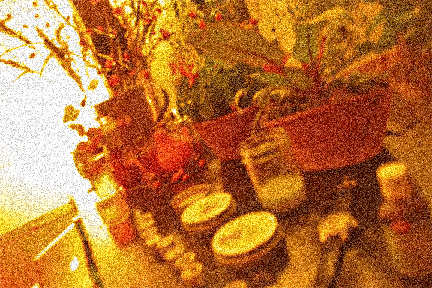
my time has been colonized by school, and work,
but tonight, I made soup and salve.
I jarred the dill I'd been drying, and brought in rosehips.
I laid the plants-in-their-pots along the counter.
I took some time to attend to the physical.
It is almost a rebellion in some ways, it is 'luxurious' time, a priviledge of the wealthy nations, and the knowledge that my life is imbricated with the political, collective, spiritual and all that.
Our daily acts, how we spend our time, our praxis are the core of meaning on many levels, discursive and ontological. Foucault saw power as a microprocess; people become subjects through their daily acts. "Acts, gestures and desire produce the effect of an internal core of substance".
Judith Butler a couple of decades later included gender as the foundation of identity: "Gender is the repeared stylization of the body, a set of repeated acts with in a highly rigid regulatory frome that congeal over time to produce the appearance of a substance, of a natural sort of being" (p.33).
We are disciplined and created as subjects of the state through "the organization and refulation of the time, space, and movements of our daily lives, our bodies are trained, shaped", we are made legible. This is Susan Bordo's brief of Foucault's description on how the 'docile body' is produced.
She explores how to leave room for rebellions. "And, third, we need a discourse that will enable us to account for the subversion of potential rebellion, a discouse that, while insisting on the necessity of objective analysis of power relation, social heirarachy, political backlash, and so forth, will nonetheless allow us to confront the mechanisms by which the subject at times becomes enmeshed in collusion witht foreces thtat sustain her own oppression."
How I am spending my time these days..
8.29.2006
autumn and closing


Harvest time.
Autumn is coming, and I begin to work circles, pulling all the ends in and storing up for winter.
I have half put the garden to bed at rare.
I harvested these tomatos, some catnip, lemon verbena, dill, mint,
and about 30lbs of potatoes. All of that felt really good.
I mean to move two thilictrum from the perrenial beds into the center circles of the demo garden, and move the three little thymes in at their feet.
I will write out a little map and guide to the garden for whoever does it next year, and I do wish that I could be here to do that.
The Garden Ninja school was fun, and super-educational for me.
I learned a lot about my own time, energy and organization,
as well as how I teach.
I am still sculpting myself,
especially socially.
If I did it again I would, in every class, make something for the office. I think that would give the class more purpose, demand our creativity, and integrate the humility and offering that comes of gardening.
Next time too, I will leave more time for the class to create their own discussion, and I will give out feedback forms.
So I did the Garden Ninja school for the first half of the year, and then I folded it in. It got too hot, me too tired, not enough committment, and there was no interest or support from rare. The energy needed to be put in did not compensate for the energy return.
The lack of integration and support from rare weighed heavy on me. There was no continuity with my little project! There was no one there who would take it on from me, no one who had any clue of what I was doing to help pass it on. I did email all emails in through the office, but no one ever came. I know that no one came because no one had time; the problems are systemic within the charity.
So I put much of the garden to bed this weekend, though tomatos, basil, peppers, sorguhm, chinese motherwort and sunflowers remain. And beets. I hope the beets get left to go to seed: they are chiogga beets ( white with concentric magenta circles).
The workshops are done.
I thank all those who came.
I hope you all learned some,
and I certainly learnt a lot.
As for rare, it is a very sick organization and I worry about its future.
Such potential...
but there is something there unspoken -
some undercurrent that is not on the table, is not healed,
and is not appeased.
blessed be.
i pray for peace, safety, and Love for the land


7.23.2006
weed to the wise
There is lovely article in The Dominion about edible 'weeds', called
Weed to the Wise.
I did the Eat Your Weeds! workshop for the Galt Horticulture Society yesterday. The few that came absorbed much and were fed by it. Aiding the process of reingaging with our landbase is nourishing, sacred work.
Weed to the Wise.
I did the Eat Your Weeds! workshop for the Galt Horticulture Society yesterday. The few that came absorbed much and were fed by it. Aiding the process of reingaging with our landbase is nourishing, sacred work.
7.12.2006
shifting, friends and zuchini brownies
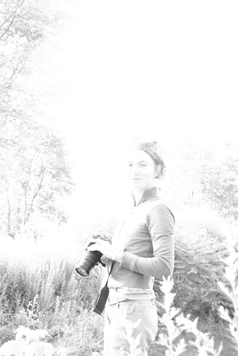


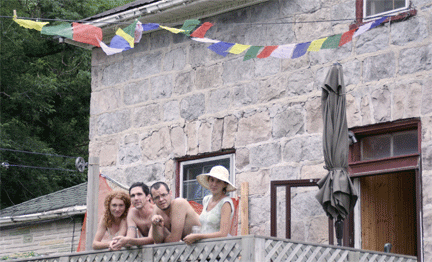
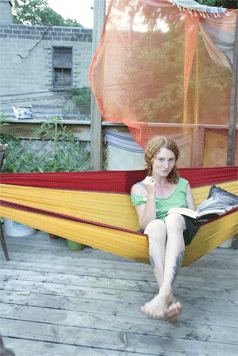
well, it is july and i feel myself shifting from outward movement, back into preparing and maintaining of self.
garden ninja school is tucked in: i am holding no more classes, but i do wish to have an evening soon when we can all hang out in the garden and share.
I will also do one more session out at rare: soil/compost/mulch: if I could simmer down the key to intentional gardening in one workshop, this is it.
I will also do a few more workshops with the Galt Hort Society, herbology and flower arranging, for those here in Cambridge.
* * *
Shifting away from teaching, and from the production agriculture of rare organics, I am now working on more creative projects of my own. I love having a bunch of jobs, things to do, and being able to shuffle them into morning and afternoon blocks, weather dependant and flexible.
I am feeling great about my work, about where I am in my journey of building skills and networking.
I am making a fleet of salves now too. Lavender salve with frankinsence and myrrh, packaged with Derrick Jensen quotes on the lids of Mason jam jars! It feels good to be creative.
"All it would take to bring (our civilization) to a halt is creativity,persistent creativity."


 *  *  *

 So most of the photos Kili took, obviously, as I am in them!  Great hey?.  We are taking lots of photos and playing around lots.  It is good:  I am learning lots from his learnings.

 The last two photos are of our porch, which has become more colorful and gorgeous than I had expected.  Joel and Zoe were through, visiting, on their way to Halifax.  Damn it is nice to see old friends.  I am excited to set up in Halifax, have chickens, and work with Zoe.  May it be, may it be.

 *  *  *
 The Zuchinis are ripening, growing as quickly out of control as zuchinis do:  wait two days and the dildo sized squash becomes large as the average housepet. Today I made the first batch of chocolate zuchini brownies, topped with cinnamon-roasted sunflower seeds. Mmmmm.

 I love days off.  Today was a rain day, the first in months.  Seriously, it has barely rained since April.  Today was the first day that rain kept me in this summer, and I admit to loving these days.  I always have.  When I was a child, these days meant that i did not have to work outside, but could cozy up and read peacefully.  I still snuggle into that magic of the coziness and safety inside.

 Before the brownies, I purified a bunch of raw beeswax that I am using to make salves, and played on the computer making labels, and playing on MySpace. What a multilayered existance us moderns can inhabit!  And I know the crash is coming.

 I am asking myself more and more seriously these days, every day,  what is it and how am I going to help take down civilization?  What can i do, and precisely how will I achieve it?  What risks will I take, and what will be the most useful, the most amplified and effective action I can participate in?

 I wish peace and clarity to all of us.

 namaste
6.04.2006



6.03.2006
energy. money. sighs. and amens for the days.
I have not been blogging as much as I want to be, as much as I envision myself writing. I have been busy in the fields the last few weeks -steady on-the-go.
The demo gardens at rare, where 'garden ninja school' takes place, are looking fantastic. (In my humble opinion). Last Tuesday, Alexander and Leah showed up early in the day so the three of us watered and mulched as much of that sweet little garden as we could. We built the compost up another layer using more of the kitchen-office compost and a fat, fresh harvest of vetch, cut to free the rhubarb and siberian irises.
After class I put in a lot of transplants that I had brought from home, and taken from the greenhouse on the production fields. Tomatos, peppers, chinese motherwort, ground cherries, tobacco, clary sage, lemon verbena, valerian, cleomes, orange cosmos.
That class was fantastic. It was the first in herbology series. We wandered the gardens, then went in the kitchen with our handfuls of green. We began a tincture and an infused oil, and made salve with an infused oil I began a few weeks ago. It was rosemary, lemonbalm and oregano, and it smells fantastic. It was a great class.
I have have been having a series of major realisations about energy, specifically petroleum and money and personal, human energy.
One Tuesday, I was in the demo garden, and I realised that I had forgotten something at home.
I considered riding home - which is about 30 mins by bicycle each way. I wondered if someone would lend me their car.
I realised that, if I chose to go, the energy it takes to get me home and back must be expended whether it is by me or by the combustion of oil. The laws of physics demand energy to move me place to place.
I get there faster on my bicycle, expending less energy, but even that equation is subsidised by the amount of energy it took to make the steel, and to make the bike. (One might argue that in riding, I do not expend less energy than I would if I walked, which is quite likely, but the time that I save does afford me more energy.)
Oil is like credit, roughly metaphored.
It is instant, and not of your own making. It is high-powered, and is more expensive than it first appears.
But, by using a money system we can give something a value that does not reflect the true 'value', but only one aspect of it.
We can make oil cheap.
'Economics is a form of brain damage'. (Goodness if I can find where I read that! It was in the new Permaculture Activist, and someone was quoting someone as saying this. I have looked, and could not find it again. )
Whether or not I knit the sweater I am wearing the energy needs to be expeded.
Money is a way of skimming the energy and re-allocating it. Subsidies, wages, 'value', coal and petroleum, all distort the true energy production and consumtion balance.
Items that are cheap - refering only to their designated monetary value- are a key to making money. Florists need to keep their container costs low, so the industry supplies stoneware and ceramic pots for $4-$8, mostly from Asia. The cute little pots are drenched in petroleum and factory labour.
Going the cheap way supports degredation somehwere else; it is a credit taken in other humans energy, and Earth's energy stores. Money has made acceptable and possible lynching another into repaying your debt.
Derrick Jensen, at some point in 'Culture of Make Believe' says something to the effect that true and persistant creativity will create the change.
Grow your own mulch. Make beads. Make medicine from herbs you grew, and art from roadside plants. Write, and observe.
Grow your own mulch. Provide for your own scene. Figure out how to work what you got into what you need. Yes, I am now veering towards a rant that stems from a difference of perspectives between the boss and I.
So often, less is more.
The demo gardens at rare, where 'garden ninja school' takes place, are looking fantastic. (In my humble opinion). Last Tuesday, Alexander and Leah showed up early in the day so the three of us watered and mulched as much of that sweet little garden as we could. We built the compost up another layer using more of the kitchen-office compost and a fat, fresh harvest of vetch, cut to free the rhubarb and siberian irises.
After class I put in a lot of transplants that I had brought from home, and taken from the greenhouse on the production fields. Tomatos, peppers, chinese motherwort, ground cherries, tobacco, clary sage, lemon verbena, valerian, cleomes, orange cosmos.
That class was fantastic. It was the first in herbology series. We wandered the gardens, then went in the kitchen with our handfuls of green. We began a tincture and an infused oil, and made salve with an infused oil I began a few weeks ago. It was rosemary, lemonbalm and oregano, and it smells fantastic. It was a great class.
I have have been having a series of major realisations about energy, specifically petroleum and money and personal, human energy.
One Tuesday, I was in the demo garden, and I realised that I had forgotten something at home.
I considered riding home - which is about 30 mins by bicycle each way. I wondered if someone would lend me their car.
I realised that, if I chose to go, the energy it takes to get me home and back must be expended whether it is by me or by the combustion of oil. The laws of physics demand energy to move me place to place.
I get there faster on my bicycle, expending less energy, but even that equation is subsidised by the amount of energy it took to make the steel, and to make the bike. (One might argue that in riding, I do not expend less energy than I would if I walked, which is quite likely, but the time that I save does afford me more energy.)
Oil is like credit, roughly metaphored.
It is instant, and not of your own making. It is high-powered, and is more expensive than it first appears.
But, by using a money system we can give something a value that does not reflect the true 'value', but only one aspect of it.
We can make oil cheap.
'Economics is a form of brain damage'. (Goodness if I can find where I read that! It was in the new Permaculture Activist, and someone was quoting someone as saying this. I have looked, and could not find it again. )
Whether or not I knit the sweater I am wearing the energy needs to be expeded.
Money is a way of skimming the energy and re-allocating it. Subsidies, wages, 'value', coal and petroleum, all distort the true energy production and consumtion balance.
Items that are cheap - refering only to their designated monetary value- are a key to making money. Florists need to keep their container costs low, so the industry supplies stoneware and ceramic pots for $4-$8, mostly from Asia. The cute little pots are drenched in petroleum and factory labour.
Going the cheap way supports degredation somehwere else; it is a credit taken in other humans energy, and Earth's energy stores. Money has made acceptable and possible lynching another into repaying your debt.
Derrick Jensen, at some point in 'Culture of Make Believe' says something to the effect that true and persistant creativity will create the change.
Grow your own mulch. Make beads. Make medicine from herbs you grew, and art from roadside plants. Write, and observe.
Grow your own mulch. Provide for your own scene. Figure out how to work what you got into what you need. Yes, I am now veering towards a rant that stems from a difference of perspectives between the boss and I.
So often, less is more.
5.21.2006
garden ninja school: may 23 and 30
garden ninja school: the seed to seed ecological gardening course
tues eve, 5-8pm,
@ rare headquarters (the big yellow building on the curve in the township of Blair)
may 23.
biodynamics and flowforms.
To be a ninja is to use the source. Ideally we take the oncoming and present energies, and do not fight them, but help them move on, directing them with our actions.
To do this, we need to be able to 'see' the energy flows and patterns.
Biodynamics is a huge subject. I intend to give an overview of Biodynamics, which is the "spiritual science" of agriculture as described by Rudolf Stiener in 1924. He draws on the ancient vision of Earth as a living creature of the cosmos, pulled by and connected to the cosmos. Biodynamics can give us a common language of the different forces and how they affect plants, animals and elements, which helps us to 'see' and 'garden' these forces.
Though it sounds a bit 'woo-woo' to us modern humans, the ideas are ancient. I really like these ideas - not as rules, but as insight.
may 30
herbology 1
On the syllabus, I scheduled soil and plant nutrition, but I feel we have covered these ideas already. The guest speaker I was hoping to bring in is not available for a few weeks. But some herbs are ready!
Lets get some tinctures and oils on the go, and begin to dry some herbs for tea. We can go over the basics of home-made herbal medicines and explore some of the better resources. Lets talk about a dehyrdator making workshop, for which we need to secure some materials.
june 6
-break-
perhaps a field trip?
tues eve, 5-8pm,
@ rare headquarters (the big yellow building on the curve in the township of Blair)
may 23.
biodynamics and flowforms.
To be a ninja is to use the source. Ideally we take the oncoming and present energies, and do not fight them, but help them move on, directing them with our actions.
To do this, we need to be able to 'see' the energy flows and patterns.
Biodynamics is a huge subject. I intend to give an overview of Biodynamics, which is the "spiritual science" of agriculture as described by Rudolf Stiener in 1924. He draws on the ancient vision of Earth as a living creature of the cosmos, pulled by and connected to the cosmos. Biodynamics can give us a common language of the different forces and how they affect plants, animals and elements, which helps us to 'see' and 'garden' these forces.
Though it sounds a bit 'woo-woo' to us modern humans, the ideas are ancient. I really like these ideas - not as rules, but as insight.
may 30
herbology 1
On the syllabus, I scheduled soil and plant nutrition, but I feel we have covered these ideas already. The guest speaker I was hoping to bring in is not available for a few weeks. But some herbs are ready!
Lets get some tinctures and oils on the go, and begin to dry some herbs for tea. We can go over the basics of home-made herbal medicines and explore some of the better resources. Lets talk about a dehyrdator making workshop, for which we need to secure some materials.
june 6
-break-
perhaps a field trip?
5.20.2006
images
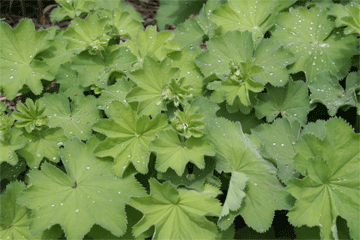

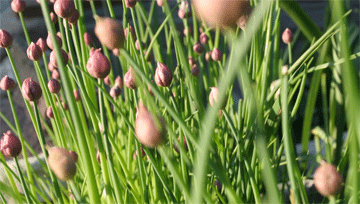
ladies mantle.
fern poppy.
chives.

ah, the mighty kale!
just 2 inches tall and perfect is the day is blue.
this is in my front yard sheet-compost garden,
mulched round with straw.
with a large squirrel population, a groundhog, a cat and 10 loud grackls
sharing the garden with me, not too much has survived out there.
a few gorgeous milk thistle, shingiku, lettuce, kale and favas rise perfect and true.

milk thistle.
The only plant which actually repairs your liver;
eat the seeds, or take them in tincture.
(I know that when transplanting it is important to keep the hearts free of soil.
It is interesting to see that these, which have come up from seed here,
are cloaked in earth.)
 in the fields of Springbank farm, farmed by rare.
early may, 2006.
photo by martha gaye, team leader, woman who orchestrates much.
 the may 20th sunset reflected in our front door.
5.14.2006
4.23.2006
weeds
those wild annuals we called 'weeds' are a secondary succession of plants that come to a wounded ecology to make it fertile enough for the next succession, which is grasses and brambles, usually.
the 'weeds', -such as plantain, dandelion, burdock, lamsquarters, pigweed, vetch, clover- help the soil by adding their tough fibre, pulling up nutrients from deep in the soil, and holding the soil tight together in protection from erosion and the harsh sun.
soil always wants a cover.
the toughest, most medicinal little plants come in and build the fertility of the soil. these plants are most often medicinal for humans too.
the soil condition -alkali, acid, fertile, etc.- can be infered by some observation of the weed guilds. Here are some indicators; (from Burbidge, Jean. "Reading Weeds on the Farm", Winter 2000, Eco-Farms and Gardens. pg13)
high soil fertility:
chickweed
chickory
groundsel
lambsquarters
acid soil:
hawkweed
dock
wild strawberry
mullein
knapweed
alkali soil:
bladder campion
wild carrot
black henbane
perrenial sowthistle
heavy clay soil:
buttercup
plantain
coltsfoot
dandelion
dock
low potassium:
eastern bracken
corn chamomile
yarrow
high potassium:
spotted water hemlock
red clover
knapweed
weeds can act as companion plants, significantly reducing insect damage.
cultivating certains weeds can as a cover crop or within your cover crop can be a free, super-nutritions, pest-controlling way of nourishing the soil.
i say 'can' because it is up to the gardener to listen to what combination and timing is going to create what ecosystem.
grasses compete with vegetable roots for nutrients: they are the next succession after weeds, and should be kept out of the garden.
nitrogen fixers:
clover
vetch
legumes
alfalfa
the 'weeds', -such as plantain, dandelion, burdock, lamsquarters, pigweed, vetch, clover- help the soil by adding their tough fibre, pulling up nutrients from deep in the soil, and holding the soil tight together in protection from erosion and the harsh sun.
soil always wants a cover.
the toughest, most medicinal little plants come in and build the fertility of the soil. these plants are most often medicinal for humans too.
the soil condition -alkali, acid, fertile, etc.- can be infered by some observation of the weed guilds. Here are some indicators; (from Burbidge, Jean. "Reading Weeds on the Farm", Winter 2000, Eco-Farms and Gardens. pg13)
high soil fertility:
chickweed
chickory
groundsel
lambsquarters
acid soil:
hawkweed
dock
wild strawberry
mullein
knapweed
alkali soil:
bladder campion
wild carrot
black henbane
perrenial sowthistle
heavy clay soil:
buttercup
plantain
coltsfoot
dandelion
dock
low potassium:
eastern bracken
corn chamomile
yarrow
high potassium:
spotted water hemlock
red clover
knapweed
weeds can act as companion plants, significantly reducing insect damage.
cultivating certains weeds can as a cover crop or within your cover crop can be a free, super-nutritions, pest-controlling way of nourishing the soil.
i say 'can' because it is up to the gardener to listen to what combination and timing is going to create what ecosystem.
grasses compete with vegetable roots for nutrients: they are the next succession after weeds, and should be kept out of the garden.
nitrogen fixers:
clover
vetch
legumes
alfalfa
4.22.2006
companion plantings
companion plantings
(from the book Culture and Horticulture, by Wolf Storl, (Wyoming, 1979) and others.
for earthworms:
stinging nettle
plantain
dandelion
thistles
strawberries: dandelions
solanacea: amaranthus
esp. pigweed.
corn: pigweed
The Three Sisters; bean, corn and squash go well together
vegetables: yarrow
valerian
for erosion:
ragweed
pigweed
clover
plantain
all the deep rooters ( burdock, dandelion, dock, thistle)
Gathered notes from hither and tither...
carrots love tomatos
things that taste good together, grow well together
legumes and alliums do not fraternize well.
brassicas like lime/alkali
potatoes do like lime
after potatoes add alkali for brassicas
potatoes do not like to follow peas
squash, cucurbitacea, solanacea: heaviest feeders
can also use second stage compost (which is less composted, still volatile: still hot)
snakes and lizards: rock piles
* * * please leave comments of other good companions you know of...
weeds
From Wolf Storl again,
Weeds act as companion plants. They reduce damage by insects. The deep rooted weeds pump up the leached-out nutrients. They add a lot of fiber for the soil. Weeds are the primary succession, the first repair after a big damage. They are tough, medicinal, small annuals that add to the soil.
Grass add brambles are the next succession: they compete with your vegetables. The weeds - they are nursing the soil.
some alleopaths:
(from the book Culture and Horticulture, by Wolf Storl, (Wyoming, 1979) and others.
for earthworms:
stinging nettle
plantain
dandelion
thistles
strawberries: dandelions
solanacea: amaranthus
esp. pigweed.
corn: pigweed
The Three Sisters; bean, corn and squash go well together
vegetables: yarrow
valerian
for erosion:
ragweed
pigweed
clover
plantain
all the deep rooters ( burdock, dandelion, dock, thistle)
Gathered notes from hither and tither...
carrots love tomatos
things that taste good together, grow well together
legumes and alliums do not fraternize well.
brassicas like lime/alkali
potatoes do like lime
after potatoes add alkali for brassicas
potatoes do not like to follow peas
squash, cucurbitacea, solanacea: heaviest feeders
can also use second stage compost (which is less composted, still volatile: still hot)
snakes and lizards: rock piles
* * * please leave comments of other good companions you know of...
weeds
From Wolf Storl again,
Weeds act as companion plants. They reduce damage by insects. The deep rooted weeds pump up the leached-out nutrients. They add a lot of fiber for the soil. Weeds are the primary succession, the first repair after a big damage. They are tough, medicinal, small annuals that add to the soil.
Grass add brambles are the next succession: they compete with your vegetables. The weeds - they are nursing the soil.
some alleopaths:
- cedar
- walnut
- sunflower
- rye
- fennel
- wormwood
- poppies
4.01.2006
Seed to Seed: syllabus overview
April 18 the Garden Ninja School's
seed to seed ecological gardening program
working with the source
seed to seed ecological gardening program
working with the source
*the structure*
Loosely, the structure will be one hour of talking ideas, details and theory
and 2 hours of working outside. Weather and sunlight dependant, we can be inside first, or after.
*the mission*
To provide the basic skills to empower good people to grow their own, produce a surplus, and live closer to Earth in a good way.
I see it as 'cottage industry' training,
and an exploration of cottage industry possiblities.
*the vision*
Imagine, (put on your rose-tinted glasses)
at the *rare* headquarters, the Lamb's Head Inn, there is a stylish and hip cafe, eatery, and art gallery, with flowers and plants for sale.
It functions as a gathering place, market and triage center for the rest of the activities on site.
The cafe has gourmet food from the fields, garnished with edible flowers, there are flowers on the tables; people can sit in the garden, amidst the birds and flowers, drinking teas grown right there.
Imagine....
I know it is a bit of a long shot, but lets garden to that end.
Growing tea herbs, culinary herbs, edible flowers and ornamental flowers seems a natural choice for the location, and provides us with a broad range of gardening experiences that can help people prepare their own future project.
While learning the basics of gardening, we can explore marketable crops, value-added products, and skills useful for the market and future.
Herbology, growing and arranging flowers, learning tea and culinary herbs, how to save seed and propogate plants, are all skills that can be further explored. This course offers a grounding in those and gardening basics.
*the syllabus*
- this is an overview, still subject to editing-
April 18. garden planning
April 25. phenology. sense of place. Permaculture overview.
May 2. compost. mulch. living mulch.
May 9. -break-
May 16. rotations. intercropping.
May 23. water. biodynamics.
May 30. soil. plant nutrition.
June 6. -break-
June 13. seed saving. seed stewarding.
June 20. solstice celebration.
June 27. herbology
July 4. -break-
July 11. weeds. pests.
July 18. flower arranging.
July 25. herbology.
August 1. -break-
August 8. bees.
August 15. marketing. business. funding.
August 22. flower arranging.
August 29. -break-
Sept 5. pesto.
Sept 12. pickling.
Sept 19. drying.
Sept 26. -break-
Oct 3. storing seed.
Oct 10. root cellaring.
Oct 17. seedy release party.
*cost*
$30/month.
Money, passion, needs, and responsibility do not often balance in our current economy. I am doing this from passion and what I feel is my responsiblity; I do need some cash flow to pay rent too. I do not want anyone to not attend because they cannot afford it; but the question of fairness to all arises, despite my knowledge of the deeper truth. If you are interested, and money is an obstacle, let's talk.
*what you will come out with*
An good idea of some things you can make and grow; the knowledge, ears, and skills to approach a piece of land and determine what the possibilities are; the growth of an intentional season.
You will go home with flowers, herbs, tinctures, salves and teas (and very possibly other treasures) at various times.
Permaculture Principles
these are some of my notes from permaculture class with Liz and Oliver.
they are a bit vague, written for myself, but hopefully the essence of the idea is still communicated.
*relative location*
*each element supports many functions*
1. Care of the Earth
2. Care of the Earth and people
self reliance, community support and interdependance (helps avoid war)
3. Give away surplus
keeps the energy flowing. Try to produce more than you consume, if possible.
4. Everything has intrinsic value
in and of themselves.
respect
balance
effeciency
simplicity
"Everything gardens."
"The problem is the solution."
"The solution is the problem."
they are a bit vague, written for myself, but hopefully the essence of the idea is still communicated.
Permaculture Principles
*relative location*
- put stuff where it makes the most sense.
- zones: are a series of proximities, according to use, with zone 1 being highest use and zone 9 being lowest use. Plant high maintanence thing in zone 1, low maintanence in further zones. ie. woodshed on the way to the outhouse
- ergonomics. efficiency. convinience. balance.
- be honest about behaviour, and go the lazy route.
*each element supports many functions*
- three functions for every element
- three elements for every function
- An used resource becomes a pollutant.
- mulitple elements for single fuctions
- Nature always has a backup plan
- eg. multiple varieties and successions
- eg. how many ways can you put out a fire
- use living resources
- all biological resources can be multifunctional. Dead things are often single use.
- eg. animal tractors, and living fences
- accelerate natural succession
- cycles through time
- edge supports more biodiversity: edges are dynamic systems
- maximize edge efficiency
- eg. keyhole beds
Permaculture Ethics
1. Care of the Earth
2. Care of the Earth and people
self reliance, community support and interdependance (helps avoid war)
3. Give away surplus
keeps the energy flowing. Try to produce more than you consume, if possible.
4. Everything has intrinsic value
in and of themselves.
respect
balance
effeciency
simplicity
Some Mollisonisms
"Everything gardens."
"The problem is the solution."
"The solution is the problem."
3.24.2006
Derrick Jensen in Guelph
April 6,
Derrick Jensen
will be speaking in Guelph in a talk titledDerrick Jensen
Endgame: The Collapse of Civilization and the Rebirth of Community.
Put on by CRFU and Healing The Earth.
After the talk, Declining Amphibian Phenomena,
some environmental anarchist, hick-hop cats from Vancouver Island will play.
big thoughts and dancing. yum.
3.23.2006
*Seed to Seed Gardening Course*
Tuesday Evenings, 5-8 at @ *rare*. Mid-April – October.
*Seed to Seed Ecological Gardening Course – Gardening with the source*
This full season course will provide a comprehensive grounding in gardening basics. Combining permaculture and a variety of gardening methods, prepare to get inspired by seed-saving, medicinal herbs, heritage flowers, and storing food for winter. Resistance is fertile, colorful, fragrant, healing and delicious.
$30 for 4 weeks or $12 drop-in.
To sign up, contact Jayme Melrose; 623 0194 or ineffable@riseup.net
Course syllabus:http://thresh_and_winnow.blogspot.com
Get your hands dirty, we will seed indoors, and
outdoors, prep a bed, talk garden design,
and check out the composts. It will be very activity orientated.
It's a good time to bring out all your questions about starting a garden,
and how to plan it to be the least amount of work,
for the most amount of beauty, life and food.
To register, contact *rare*: 519.650.9336
*Seed to Seed Ecological Gardening Course – Gardening with the source*
This full season course will provide a comprehensive grounding in gardening basics. Combining permaculture and a variety of gardening methods, prepare to get inspired by seed-saving, medicinal herbs, heritage flowers, and storing food for winter. Resistance is fertile, colorful, fragrant, healing and delicious.
$30 for 4 weeks or $12 drop-in.
To sign up, contact Jayme Melrose; 623 0194 or ineffable@riseup.net
Course syllabus:http://thresh_and_winnow.blogspot.com
April 11 5-7pm
@ *rare*
Introduction to Organic Gardening.
@ *rare*
Introduction to Organic Gardening.
Get your hands dirty, we will seed indoors, and
outdoors, prep a bed, talk garden design,
and check out the composts. It will be very activity orientated.
It's a good time to bring out all your questions about starting a garden,
and how to plan it to be the least amount of work,
for the most amount of beauty, life and food.
To register, contact *rare*: 519.650.9336
3.14.2006
benevolant allies
Bioremediation. Inciting life back into wounded soil.
Compacted, contaminated, and misused soils need help if we plan to grow food, or anything else. I do not buy the technology-will-save-us argument, and most of us earthworkers could not afford the technology anyway. One of the main permaculture tenents is "Use biological resources whenever possible." Benevolant biological allies abound: here, I have gathered what I know, and have found, regarding using life to bring life back to wounded Earth.
To start with, OM.
The sound that began the universe, in Hindu mythology, is also the acronym for Organic Matter. Biodegraded biomass, humus, compost, black soil.
Organic matter seems to buffer all defeciencies and excesses for plants. Plants can take up more nutrients when soil has high levels of organic matter, and the harmful effects of allelopathic debris, like cedar needles or walnut leaves, are ameolierated.
Compost is a shrapnel approach, as Oliver would say, in that you get a lot of coverage for your bang. Not only does compost help retain moisture, and supply nutrients, but it is full of the biological activity that breaks down complex chemical bonds into useable units that plants can uptake.
Go into a forest and observe the forest floor. Think about the leaf cycles and how the forest maintains its fertility. Think about the primary decomposers: birds, beetles, fungi, worms, and the itty-bitty bugs and bacteria we don't often see.
Ideally, as humans our intervention is an acceleration of succession.
To conceptualize succession, imagine a landslide or a clearcut. What are the first plants to appear after the devastation? What next, which prepares the way for what? What is the ecosystem climax?
A good way to observe succession is to observe ruderal ecologies. The plants that first come in to heal the Earth are, poignantly, the plants which heal humans as well. Many 'weeds' are also indicator species, revealing a content of the soil below. Biomining is a large scale application of it.
In the clearcuts of BC, first come the annuals, then the alders -which are a deciduous, fast growing, nitrogen-fixer that support mushroom growth and add lots of organic matter,- and provide a shade layer for the next succession of trees. And so on, the forest builds until it reaches its stable climax we see as 'old growth'.
So what can we add to accelerate this natural succession?
Soil needs to be alive. Organic matter, insects, micro-organisms and fungi are the primary decomposers that work in harmony to break it all down so that the plants can use it.
Currently, Paul Stamets is researching, discovering, and cultivating fungi that break down petrochemicals, filter water, denature toxic wastes, accelerate the growth of planted trees, hold together eroding roads, and improve human health. This Alternet article on him is great.
He has created a series of products called MycoGrow, which are mycorhyzal innoculants that improve plant growth. I have seen some experiments done with them, all that showed noticably improved growth with of the innoculated plants. I ordered some this spring and am doing my own set of experiments this summer.
Back on Cortes, our permaculture class spent a day with Paul Stamets and his crew, helping haul buckets of innoculated bark mulch up the clearcut he bought. There is even a photo of Gillie and I in action on Oli's blog.
Right now in New Orleans some really interesting projects are going on. In the aftermath of the hurricane, the land is toxified, houses are mold ridden, and the government could only provide some short term 'help'. A grassroots, low-tech, permaculture movement has created the Common Ground Collective. The little flick they posted, Solidarity Not Charity, is worth watching.
In the aftermath of the hurricane, the EPA did a series of soil tests which revealed varying soil toxicisity. There are lots of heavy metals in the soil, and some serious petroleum spills that occured. Starhawk, -author, witch, and permaculture designer-, is doing some large scale bioremediation projects there. On the bottom of her site, she has 5 blogs on the project, best read from the bottom up.
Compacted, contaminated, and misused soils need help if we plan to grow food, or anything else. I do not buy the technology-will-save-us argument, and most of us earthworkers could not afford the technology anyway. One of the main permaculture tenents is "Use biological resources whenever possible." Benevolant biological allies abound: here, I have gathered what I know, and have found, regarding using life to bring life back to wounded Earth.
To start with, OM.
The sound that began the universe, in Hindu mythology, is also the acronym for Organic Matter. Biodegraded biomass, humus, compost, black soil.
Organic matter seems to buffer all defeciencies and excesses for plants. Plants can take up more nutrients when soil has high levels of organic matter, and the harmful effects of allelopathic debris, like cedar needles or walnut leaves, are ameolierated.
Compost is a shrapnel approach, as Oliver would say, in that you get a lot of coverage for your bang. Not only does compost help retain moisture, and supply nutrients, but it is full of the biological activity that breaks down complex chemical bonds into useable units that plants can uptake.
Go into a forest and observe the forest floor. Think about the leaf cycles and how the forest maintains its fertility. Think about the primary decomposers: birds, beetles, fungi, worms, and the itty-bitty bugs and bacteria we don't often see.
Ideally, as humans our intervention is an acceleration of succession.
To conceptualize succession, imagine a landslide or a clearcut. What are the first plants to appear after the devastation? What next, which prepares the way for what? What is the ecosystem climax?
A good way to observe succession is to observe ruderal ecologies. The plants that first come in to heal the Earth are, poignantly, the plants which heal humans as well. Many 'weeds' are also indicator species, revealing a content of the soil below. Biomining is a large scale application of it.
In the clearcuts of BC, first come the annuals, then the alders -which are a deciduous, fast growing, nitrogen-fixer that support mushroom growth and add lots of organic matter,- and provide a shade layer for the next succession of trees. And so on, the forest builds until it reaches its stable climax we see as 'old growth'.
So what can we add to accelerate this natural succession?
Soil needs to be alive. Organic matter, insects, micro-organisms and fungi are the primary decomposers that work in harmony to break it all down so that the plants can use it.
Currently, Paul Stamets is researching, discovering, and cultivating fungi that break down petrochemicals, filter water, denature toxic wastes, accelerate the growth of planted trees, hold together eroding roads, and improve human health. This Alternet article on him is great.
He has created a series of products called MycoGrow, which are mycorhyzal innoculants that improve plant growth. I have seen some experiments done with them, all that showed noticably improved growth with of the innoculated plants. I ordered some this spring and am doing my own set of experiments this summer.
Back on Cortes, our permaculture class spent a day with Paul Stamets and his crew, helping haul buckets of innoculated bark mulch up the clearcut he bought. There is even a photo of Gillie and I in action on Oli's blog.
Right now in New Orleans some really interesting projects are going on. In the aftermath of the hurricane, the land is toxified, houses are mold ridden, and the government could only provide some short term 'help'. A grassroots, low-tech, permaculture movement has created the Common Ground Collective. The little flick they posted, Solidarity Not Charity, is worth watching.
In the aftermath of the hurricane, the EPA did a series of soil tests which revealed varying soil toxicisity. There are lots of heavy metals in the soil, and some serious petroleum spills that occured. Starhawk, -author, witch, and permaculture designer-, is doing some large scale bioremediation projects there. On the bottom of her site, she has 5 blogs on the project, best read from the bottom up.
We spend the day going over the toxins that have been found in New Orleans’ soil, and the three basic methods of bioremediating them—using microorganisms, using fungi and mushrooms, and using plants. We divide people into different groups for hands-on practice, making compost, starting worm bins (worm castings are the major source for the microorganisms we culture), starting seeds and taking cuttings, and inoculating strata with mushroom spawn.Somewhere in there she mentions they are using worm castings as the base for their 'biobrew'. It sure makes a lot of sense to me: worms are like little moving tubes that digest and purify all that passes through them, leaving life behind them.Some toxins, like diesel range organics, are big, chainlike molecules mostly composed of carbon, hydrogen and oxygen, and can be broken down into harmless substances like carbon dioxide and water. Beneficial bacteria can do the job, and so can enzymes released from fungal mycelium, the underground weblike matrix from which mushrooms emerge. We intend to do some trials with mushrooms, but its harder to grow mushrooms on a mass scale than it is to culture bacteria, so we’re starting with the brews of aerated compost tea. We’re also using a different preparation of micro-organisms, known as Efficient Micro-organisms, which is anaerobic and has many different uses. The house-gutting crews have been spraying it to counteract mold, with great effectiveness. They’ve had assistance from someone who does professional mold abatement and who has the equipment to do spore counts before and after. The bacteria and yeasts in the EM spray eat the mold spores and then colonize the surfaces mold grows on, preventing its regrowth. It’s non-toxic and much safer to use than bleach, and more effective. It’s success against mold has made me wonder if it would also be effective against Sudden Oak Death, the fungus-like disease that is devastating our forests in Northern California. The company that produces EM, and has donated a lot of it to Common Ground, has offered to bring a mobile processing unit down to New Orleans to produce it on a mass scale. But they have been unable to get the funding—nearly $200,000—they need in order to do so.
EM is mostly anaerobic—the organisms involved do not need or want air in order to reproduce. We’re also experimenting with EM sprayed on the soil, to see if it will help get life back into the dead, compacted, muddy sediments.
It’s exciting. It’s also uncharted territory. Lots of people have worked on bioremediation, in the lab, on highly toxic sites, in well funded cleanup efforts. We don’t know of anyone who has tried it on a low-budget, mass movement backyard scale.
And more, some underlying force of health and life and serendipity that we tap into when we do this healing work. There’s an excitement, a sheer raw energy unleashed that animates the digging forks and keeps us working joyfully and eagerly into the twilight. It’s as if the earth herself wants to be healed, and when we take on that work, we tap into an upwelling spring of life giving power. Out of nowhere, benevolent allies appear.
3.13.2006
UWaterloo community garden
UWaterloo Community Garden
Spring 2006
Spring 2006
Resistance is fertile.
Next community garden meeting will be April 12 at 5pm, at the EScourtyard.
We will all head out for a tour of the garden and check it out.
I am not going to worry about set up any times to run workshops. I am going to focus on *rare* for all of that, and learn from the community garden experience. If anybody wants to learn something specific that I can help accelerate, I will do my best.
I do hope to put in a patch of perrenial herbs for culinary and medicinal uses. Permanent mulch styles if possible. We will see how the land allocation settles out.
I would love to help cultivate a herbology collective.
Subscribe to:
Posts (Atom)